

Why Are Slat Acoustic Panels Transforming Modern Interior Acoustics?
2025-12-05
Slat acoustic panels are emerging as one of the most effective solutions for balancing style and sound control in residential, commercial, and industrial interiors. Designed with precision-cut wood slats bonded to high-density acoustic backing materials, these panels provide a dual advantage: visual enhancement and measurable acoustic performance.
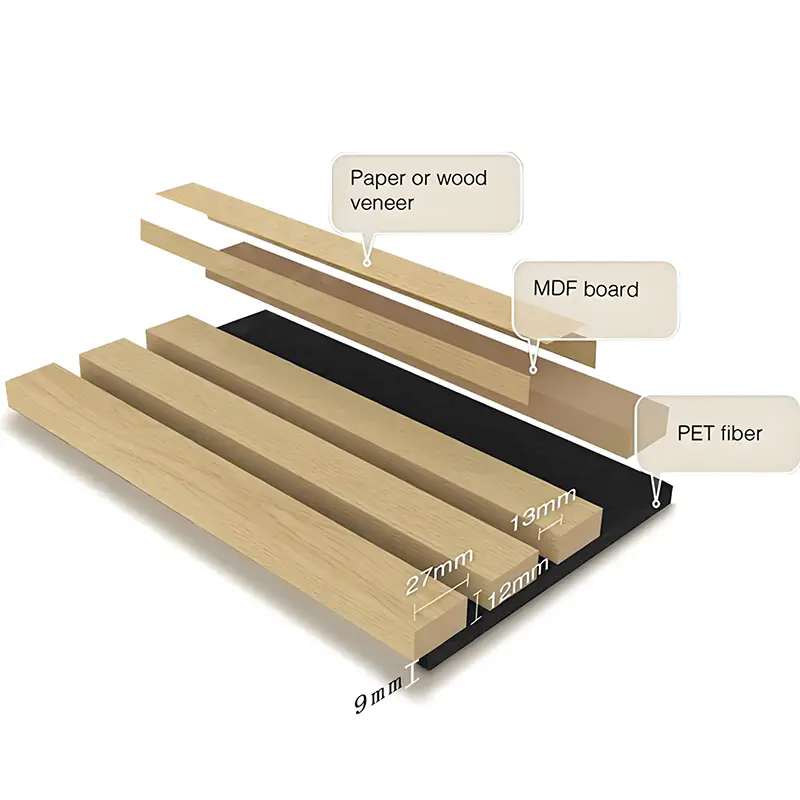
Slat acoustic panels operate on a hybrid mechanism that combines sound absorption, diffusion, and resonance control. Their wood-slat structure breaks up reflective sound waves, while the acoustic felt backing captures and dissipates energy across mid- and high-frequency ranges. This balanced performance makes them ideal for offices, theaters, restaurants, studios, home interiors, and public facilities.
Key performance advantages include:
-
Reduced echo and reverberation
-
Improved speech clarity
-
Enhanced audio mixing accuracy
-
Consistent acoustics without visible foam-based treatment
-
Strong decorative impact aligned with architectural aesthetics
Below is a structured overview of typical product parameters for advanced slat acoustic panels:
Slat Acoustic Panel Specifications
| Parameter | Description |
|---|---|
| Panel Size | 2400 × 600 mm, 2800 × 600 mm (custom lengths available) |
| Slat Material | MDF / solid wood veneer / natural oak, walnut, teak options |
| Acoustic Backing | Polyester fiber felt (PET), 100% recyclable |
| Slat Dimensions | 27 mm width × 15 mm thickness (varies by model) |
| Gap Between Slats | 13 mm typical for balanced absorption/diffusion |
| Fire Rating | Optional Class A / Class B |
| Acoustic Performance | NRC 0.75–0.95 depending on installation depth |
| Installation Method | Direct screw mount, batten frame, or clip-on system |
| Environmental Compliance | E0/E1 formaldehyde rating, low-VOC option |
These specifications illustrate how materials, dimensions, and construction directly influence acoustic behavior. High-density felt increases energy absorption, while slat geometry disperses sound reflections.
How Can Slat Acoustic Panels Be Installed to Maximize Performance?
The effectiveness of a slat panel system depends heavily on installation strategy. Correct spacing, wall condition, room geometry, and mounting depth all influence real-world acoustic results. Understanding how installation contributes to performance helps architects and builders deliver superior environments.
How Installation Depth Affects Absorption
-
Direct wall mounting targets mid-frequency absorption.
-
20–45 mm airflow gap improves low-frequency handling.
-
Battens or secondary frames allow hidden cable routing in commercial projects.
How Slat Direction Influences Acoustic Behavior
-
Vertical slats enhance vertical diffusion, ideal for tall spaces and hallways.
-
Horizontal slats reduce lateral flutter echo in wide rooms.
How to Optimize Room Coverage
-
Covering 25–35% of wall area significantly changes room dynamics.
-
Strategic placement behind speakers, workstations, or dining areas enhances clarity.
-
Ceiling applications offer the highest impact in reverberant spaces.
Common FAQ Section (1)
Q: How does the slat spacing affect sound absorption efficiency?
A: Slat spacing determines how much sound can penetrate the gaps and reach the felt backing. Wider gaps allow more mid-frequency sound energy to be absorbed, while narrower gaps emphasize diffusion. Balanced spacing—typically around 13 mm—achieves a mix of both, making the panel effective across a broad acoustic range.
Q: How long does installation typically take, and what tools are required?
A: For a standard room, installation may take 2–6 hours depending on coverage. The process requires basic tools such as screws, adhesive, a drill, level, and cutting equipment if adjustments are needed. Pre-mounted battens may accelerate installation, especially in commercial setups requiring concealed wiring or custom alignment.
How Are Slat Acoustic Panels Being Used Across Residential and Commercial Spaces?
Slat acoustic panels are gaining traction because they solve sound-related issues without compromising aesthetics. Their adaptability supports multiple usage scenarios, from functional sound control to premium interior design.
Residential Applications
-
Home theaters: distortion reduction and immersive audio
-
Living rooms: improved conversation clarity
-
Bedrooms: noise control for restful environments
-
Home offices: enhanced focus and reduced echo during calls
Commercial Applications
-
Corporate offices: reduces noise fatigue and boosts productivity
-
Hospitality venues: enhances dining ambience and speech clarity
-
Music studios: controls reflections without deadening the room
-
Retail stores: strengthens customer experience and brand feel
Architectural and Design Benefits
-
Warm, natural wood look complements Scandinavian, minimalist, industrial, and contemporary design themes
-
Consistent modular size simplifies large-scale wall cladding
-
Versatile color and veneer options support custom brand identity
-
Durable materials maintain structural and aesthetic integrity over time
Common FAQ Section (2)
Q: How do slat acoustic panels compare to traditional foam or fabric panels?
A: Foam panels absorb sound effectively but lack architectural appeal and degrade visually over time. Fabric panels provide cleaner aesthetics but remain limited in style variation. Slat acoustic panels deliver competitive absorption while offering superior visual warmth, durability, and flexibility, making them suitable for both functional and decorative use.
Q: Are slat acoustic panels suitable for humid or high-traffic environments?
A: Panels made from treated MDF and moisture-resistant finishes can perform well in moderately humid spaces. For high-traffic areas such as hallways or commercial lobbies, panels with reinforced slat coatings maintain appearance despite frequent contact. Proper care and surface treatment enhance longevity in demanding environments.
How Will Future Trends Shape the Development of Slat Acoustic Panels?
The demand for acoustic comfort continues to rise globally as open-plan environments, remote work, and multimedia consumption expand. These lifestyle changes influence how slat acoustic panels evolve across design, sustainability, and performance dimensions.
How Sustainability Is Driving Future Material Innovation
Manufacturers are shifting toward eco-friendly materials such as:
-
Recycled PET acoustic felt
-
FSC-certified wood veneers
-
Low-emission binders and adhesives
-
Carbon-reduced MDF and natural fibers
These improvements align with global environmental standards and appeal to eco-conscious architects and homeowners.
How Manufacturing Technology Is Expanding Customization
CNC precision cutting and automated finishing allow:
-
Custom slat widths and patterns
-
Panel integration with lighting features
-
Curved and 3D wall applications
-
Color-matched finishes for luxury interiors
This level of customization positions slat panels as both a technical and artistic solution.
How Acoustic Science Is Leading to Performance Enhancements
Ongoing research focuses on:
-
Multi-layer absorption systems for wider frequency response
-
Low-frequency resonance chambers built into panel structures
-
Hybrid PET-wood composites for higher stiffness and lower weight
-
Integrated diffusers for premium listening rooms
These innovations will elevate slat acoustic panels from decorative solutions to advanced architectural acoustic systems.
How Global Market Demand Is Expanding Applications
-
Builders use them to meet stricter acoustic codes.
-
Designers incorporate them into high-end projects for texture and depth.
-
Consumers select them for aesthetic upgrades with functional benefits.
-
Corporate environments adopt them for wellness-driven workspaces.
This sustained demand ensures the category will continue evolving rapidly.
Why Choosing Premium Slat Acoustic Panels Matters
Slat acoustic panels have proven to be a transformative solution for spaces that require both style and sound control. Their combination of structured wood design, high-performance acoustic backing, and versatile installation options makes them valuable across residential, commercial, and industrial environments. As innovation continues, the future points toward improved sustainability, advanced acoustic engineering, and fully customizable architectural applications.
For projects requiring reliable quality, precise construction, and consistent acoustic results, QDBOSS stands as a trusted manufacturer delivering durable, visually refined, and performance-oriented slat acoustic panel solutions.
For customized specifications, technical guidance, or bulk project support, contact us to receive professional assistance tailored to your acoustic and design requirements.