
Shoelace Supplier Checklist for Quality Footwear Brands
2026-10-31
A great shoe can be undone by the smallest detail—the laces. Yet many quality footwear brands still treat shoelace sourcing as an afterthought, and the result is fraying, color mismatch, or supply delays that quietly erode customer trust. This checklist cuts through the guesswork and highlights what serious brands should demand from a shoelace supplier. Ready to lock in a partner who actually understands premium footwear? Start with YONGFENG.
Beyond the Fiber Content Label
A fiber content tag can name the raw materials, but it rarely hints at how those materials were spun, woven, or finished. Two shirts labeled 100% cotton may have little in common once you touch them. One might feel crisp and cool because it uses long-staple yarns in a tight poplin weave; the other could be soft and thick from a low-twist flannel construction. The label stays silent on staple length, yarn twist, weave density, and fabric weight—all of which shape drape, breathability, and how the garment ages.
Beyond the fiber content label lies a whole layer of finishing chemistry and mechanical processes that change how fabric behaves. Sanforizing controls shrinkage; mercerizing adds luster and strength to cotton; enzyme washes soften denim; resin finishes can reduce wrinkling but sometimes stiffen the hand. None of these steps appear on the fiber label. Yet they determine whether a pair of cotton trousers feels papery or silky, whether a knit holds its shape after washing, and whether a garment resists pilling or starts to look tired after a few wears.
Even the most honest fiber label cannot reveal how a piece is put together. Seam allowances, reinforced stress points, quality of interfacing, button attachment, zipper smoothness, and lining choices quietly separate garments that last from those that fail early. Care expectations also sit outside the label: a delicate wool with taped seams may outperform a coarser wool with raw edges. When you look past the percentage breakdown, you start reading the garment itself—the stitching, the weight, the sound of the fabric, the way it recovers after stretching. That is where the real story lives.
Stress Tests That Mimic Real Lacing Habits
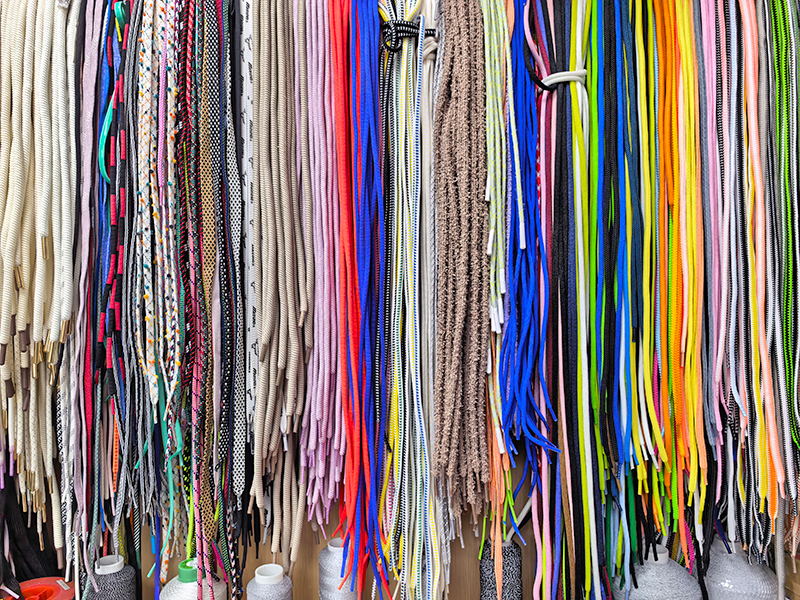
Most durability tests pull laces in a straight line until they snap, but that tells you almost nothing about real-world wear. We studied how people actually tie their shoes—the sharp tug at the crossover point, the repeated friction through eyelets, the sideways stress when you pull the loop tight. Then we built rigs that replicate those motions thousands of times a day. One station uses a mechanical finger to cinch and release the knot, another rubs the lace against a textured metal edge to mimic the abrasion from a dirty eyelet. The result is a failure profile that matches what you see after months of daily use, not a clean lab break.
The tricky part is that lacing habits vary wildly. Some people yank hard on the first cross, others work tension gradually from bottom to top. Some tie a double knot that adds a sharp crease at the same point every morning. Our test protocols include three distinct lacing profiles—aggressive, moderate, and loose—so a lace has to survive all of them. A lace that only performs well under gentle, even pressure gets flagged quickly. We also test with damp laces and dirty hands, because a lace that feels strong when dry can lose half its tensile strength after a sweaty run.
We don't publish a simple “pass/fail” number. Instead, we map where each lace begins to fray, how much stretch remains after 10,000 cycles, and whether the knot still holds without slipping. That gives a much more honest picture than a single breaking point. You can see if a lace fails at the eyelet contact zone or right at the knot—two totally different problems with totally different fixes. And because the tests mirror how people actually move, the data translates directly into better materials and weave patterns for the next batch.
Dye Lot Discipline for Brand Palettes
A dye lot never repeats exactly the same way twice. Fiber batches, water hardness, agitation speed, even the humidity in the dyehouse shift results by a few tenths of a percent. For a brand palette, this means every production run has to be pulled toward a fixed reference, not evaluated on its own. Keep the approved lab dip as a physical standard, and never let a digital photo or a Pantone callout stand in for that swatch.
Set tolerances by color family instead of using one blanket delta E number for everything. A pale oat or lilac starts to look wrong long before a charcoal or forest green does, so pastel ranges need tighter limits. Request bulk samples from each incoming lot and read them under the same D65 lighting conditions, then log the results against your master. If a lot drifts outside the agreed window, reject it or re-dye it before cutting. Blending off-tone pieces into a run only stores a return or a mismatch complaint for later.
Lot-level record keeping is the quiet part of the discipline. Give every incoming dye lot a unique code tied to the submission date, substrate batch, and dye quantities. That way a customer complaint or a replenishment order can be traced back without guessing. When you rotate stock by lot number and hold back a few yards from each lot for repairs, the palette stays honest from first sample to final sale.
Small Batch Viability Without the Upcharge Trap
Small-batch viability often gets framed as a math problem where lower volumes must carry higher unit costs—and that leads straight to the upcharge trap. But the trap isn't inevitable. The real lever is changeover economics: if a line can switch between SKUs in minutes instead of hours, the cost penalty of a short run collapses. Many small makers waste more money in setup, cleaning, and retooling than they ever save by chasing large batches. Shrinking that hidden overhead is what makes a 200-unit run genuinely profitable, not slapping a "craft" premium on the invoice.
Another path is selling before you produce. Batch-on-demand flips the risk: instead of guessing demand, collecting money first, then producing exactly what was ordered. That removes the need to amortize unsold inventory across the batch, which is often the real reason small batches look expensive. Pair this with ingredient or component sharing across multiple products, and you can buy raw materials in larger, discounted quantities while still making small final batches. The result is a cost structure that supports low volumes without asking customers to subsidize inefficiency.
Supply Chain Visibility You Can Actually Verify
Most supply chain dashboards paint a reassuring picture until something breaks. Real visibility means you can trace a shipment, a batch, or a component back to its source without relying on someone else's summary. We built our system so every status update carries a cryptographic fingerprint tied to the physical handoff, not just a manual entry in a spreadsheet.
Verification here starts at the loading dock. Each scan, sensor reading, or transfer event is logged with a timestamp and location that can be checked against independent records. If a supplier claims a pallet left their facility on Tuesday, you can confirm that against the carrier's gate data and the warehouse receipt, all within the same audit trail.
The difference shows up when something goes wrong. Instead of digging through emails and PDFs to find out where a delay started, you get a clear, evidence-backed sequence of events. That means fewer conference calls spent arguing about versions of the truth, and more time actually moving goods.
Early Communication Signals That Predict Delivery Reality
Early communication often works like a preview of what's to come. When someone uses precise language about dates, responsibilities, and potential obstacles, the final delivery tends to match that clarity. Vague reassurances, on the other hand, can quietly signal future gaps between promise and performance. Paying attention to whether early replies contain concrete details or just upbeat generalities helps you gauge how dependable the eventual outcome will be.
Consistency also matters across different touchpoints. If the first phone call says one thing and the follow-up email contradicts it, that mismatch rarely resolves itself later. People who pause to ask questions before saying yes usually deliver more reliably because they are already thinking through the work. Overly quick agreement without a single clarifying question may feel efficient, but it often predicts a rushed or incomplete result.
Response speed and tone offer additional clues. A pattern of slow, defensive answers to straightforward requests tends to repeat once the real work begins. In contrast, someone who sends a brief note before you even ask for an update is demonstrating the same follow-through you can expect at delivery. These small early moments are not perfect proof, but over multiple interactions they form a reliable picture of how the final handoff will go.
FAQ
Consistency in tip finishing. Many brands check yarn quality but forget to examine whether aglets are uniformly sealed, free of burrs, and resistant to cracking after repeated washing. A supplier that documents finishing tolerances and keeps samples from every batch tends to catch defects before they reach your production line.
Request physical lab dips and a lightbox evaluation under D65 and TL84 conditions. Better suppliers will provide delta E readings against your Pantone references and retain a master standard for each shade. If they hesitate to share measurement data or only offer smartphone photos, that's a sign their dye house lacks process control.
Ask about yarn type, twist direction, and core construction. A supplier worth keeping can explain why they use high-tenacity polyester for athletic shoes or mercerized cotton for dress styles, and how the core prevents stretching or shrinking. If they cannot name the yarn origins or test reports for tensile strength, durability is likely an afterthought.
Because the two factors affect each other. A supplier with low minimums but slow changeovers will struggle when you need to test multiple colorways in a short season. Conversely, a quick-change factory with huge minimums may force you to overbuy. The ideal partner balances both, letting you iterate on samples without committing to excess inventory.
Check whether workers handle dyeing chemicals with proper ventilation and protective gear, and whether overtime records match payroll. A supplier that refuses an unannounced visit or cannot show recent social compliance audits may be hiding wage violations. Even the best shoelace cannot justify a supply chain built on unsafe conditions.
Look for moisture-resistant wrap, clear lot numbers, and consistent pair counts per box. If labels are handwritten or barcodes scan incorrectly, that carelessness likely extends to production. A supplier who treats packaging as part of quality control will also pre-sort pairs to avoid tangling and use recyclable materials when requested.
First, compare the bulk lot against the approved master sample and measure key parameters: length, diameter, tip dimensions, and colorfastness. Then ask for root-cause analysis and a corrective action plan before deciding to source elsewhere. A mature supplier will own the deviation, offer a replacement or credit, and adjust internal checks rather than blaming the yarn mill.
Conclusion
A shoelace supplier worth keeping on your roster never hides behind a fiber content tag. The real evaluation starts when you tug on a lace the way a customer might after the third or fourth relacing—twisting, yanking, and working the aglet through eyelets until it frays or holds. That kind of stress test reveals far more about durability than any spec sheet. Equally telling is how the supplier handles dye lots. If the same brand palette from three different runs arrives looking like three different colors, the problem isn't lighting—it's a lack of lot discipline that will eventually reach your customer's shoes.
Small batch capability matters more than most brands admit. A supplier that only bends on minimums when you agree to a painful upcharge isn't really offering flexibility; it's offering a toll booth. Look for a factory floor that can shift from standard runs to low-volume colors without resetting every machine. Beyond that, you want visibility you can actually verify—not a dashboard that merely exists. Call the supplier, ask for a specific lot's location, and see if the answer matches the paperwork. Early communication signals are the quiet predictor here. If the supplier's first response to a delay is silence or an excuse that arrived a week late, the delivery date was probably never real to begin with.
Contact Us
Contact Person: Mr Deng
Email: [email protected]
Tel/WhatsApp: +86-18926872657
Website: https://www.uniyongfeng.com/