

MNS Switchgear Exporter for Reliable Low-Voltage Power Distribution Systems
2026-10-13
Low-voltage power distribution is only as reliable as the switchgear at its core. For projects where downtime isn't an option, sourcing MNS switchgear from an exporter who understands the stakes makes all the difference. MOLDVOLT has built its reputation on delivering exactly that—MNS switchgear engineered for dependable, long-term performance. Here's what to look for when choosing a partner for your low-voltage distribution needs.
The Real Reason MNS Switchgear Keeps Showing Up in Low-Voltage Tenders
Ask any panel builder why they keep recommending MNS switchgear for low-voltage tenders and you rarely hear “innovation” as the first answer. The real driver is modularity that holds up under last-minute design changes. Fabricators can add, remove, or reorganize compartments without ripping out busbars or re-engineering an entire lineup. In tender phases where specifications shift right up to the deadline, that flexibility quietly removes a huge amount of risk from the bid.
Another quieter reason is the repair path. Low-voltage infrastructure tends to outlive the people who install it, so maintenance crews develop deep familiarity with certain form factors. MNS has been around long enough that troubleshooting, spare parts, and retrofit kits are almost boring to source. That predictability makes life easier for facility owners who have zero interest in re-training electricians every time a new project lands in their lap.
There is also a self-reinforcing cycle in tender documentation. Once a few large utilities or industrial sites standardize on MNS-style construction, their template specs start carrying language that effectively filters out anything else. Withdrawable units, specified degrees of internal separation, and arc containment numbers all start pointing in one direction. Contractors learn to read those cues and simply stop proposing alternatives, not because they are worse, but because the path of least resistance happens to run through the same familiar grey enclosures.
What Happens Before an MNS Panel Leaves the Exporter's Floor
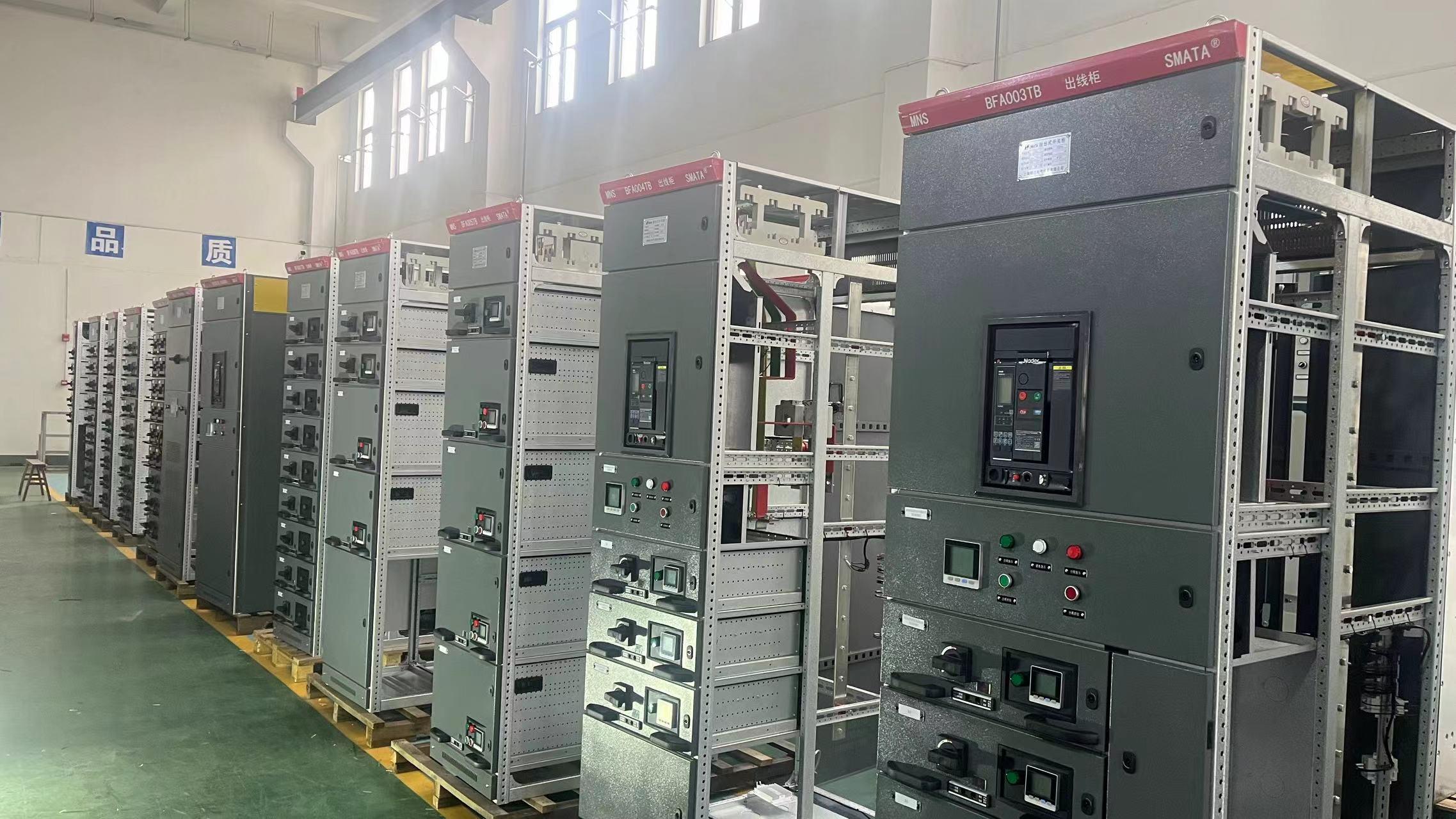
Every MNS panel goes through a final walk-down before release. Technicians trace the entire busbar run, checking torque marks on every bolted joint and verifying phase sequence against the approved single-line diagram. Any scratch on paint gets touched up, and all foreign material like cable offcuts or metal shavings is blown out with dry compressed air. The panel nameplate, mimic layout, and warning labels are cross-checked with the packing list so no variant mixes slip through.
Electrical checks are not rushed. Insulation resistance is measured between phases and to earth at 500V or 1000V DC, depending on the rating. Breakers are manually operated several times, then put through their protection trip tests with primary injection on key feeders. Interlocks between bus couplers and incomers are exercised in every possible sequence, including the ones that should be rejected. Auxiliary circuits, from space heaters to communication modules, are verified point-to-point with the wiring schedule.
Only after that does packing start. Loose parts like breaker handles, earthing trucks, and spare fuses get wrapped and fixed inside the panel or in a separate case bolted to the base. Each shipping section is protected with polythene, corner protectors, and sometimes a wooden crate if the route involves transshipment. A final photo record is taken against the door-open and door-closed checklist, and the test certificates plus a signed defect-free release note go into the document pouch before the panel is moved to the loading bay.
Small Design Tweaks That Give MNS Switchgear an Edge in Arc Flash Safety
MNS switchgear earns its reputation in arc flash safety through a series of quiet, thoughtful adjustments that rarely show up on spec sheets. Take the door latch assembly, for instance. Instead of a simple bolted closure, the MNS uses a reinforced hinge pin with a slight offset that allows the door to flex inward under rising pressure, absorbing the initial shockwave before the pressure relief system kicks in. This tiny geometric change prevents the door from becoming a projectile during the most violent phase of an arc fault.
The busbar support spacing is another example of a small design choice with outsized consequences. By reducing the unsupported span by just a few centimeters compared to conventional layouts, MNS limits how far the conductors can whip under magnetic forces during a short circuit. That restrained movement lowers the odds of a developing phase-to-phase fault escalating into a full-blown arc blast. No extra parts, no added cost—just a measurable improvement in passive protection.
Even the pressure relief vents on the MNS top cover carry a deliberate twist. They are not simple rectangular openings but rather a series of angled baffles arranged in a stepped pattern. This configuration redirects superheated gases and molten debris away from the typical operator walkway, funneling them toward a safer zone instead. It is the kind of detail that never appears in marketing photos but makes a real difference when someone needs those extra seconds to reach the emergency exit.
Why Overseas Buyers Prefer MNS for Retrofitting Older Power Rooms
Older power rooms rarely offer generous space or a simple, uniform layout. Overseas buyers lean toward MNS for retrofits because the modular frame and withdrawable drawers allow them to work around existing busbar routes and cable entry points without tearing out the entire installation. Instead of a prolonged shutdown, the retrofit can happen in stages, keeping critical sections live while outdated panels are replaced one by one.
Another factor is confidence under fault conditions. MNS switchgear is type-tested and carries clear arc-fault containment ratings, which matters when a facility has to satisfy different national safety codes and local inspection practices. Rather than relying on a custom-built solution that demands special engineering review at every step, buyers get a proven design that local contractors already understand, reducing installation errors and commissioning time.
Long-term maintenance also plays a decisive role. Because MNS relies on standardized modules and busbar systems, adding a new feeder or swapping a drawer years later doesn't turn into a search for obsolete parts. For overseas buyers, that predictable spare parts supply and straightforward expansion path makes the retrofit less of a one-off project and more of a lasting upgrade.
A Day in the Life of an MNS Switchgear Installation Team
The alarm goes off at 5:30 a.m. and the crew meets at the warehouse, checking the load list twice before the flatbed rolls out. For an MNS switchgear installation team, the morning is pure logistics: torque wrenches, cable cutters, insulated gloves, and the ever-present stack of single-line diagrams. By the time the sun clears the industrial park, they're already on site, walking the switchgear room with the site supervisor, marking busbar routes and cable tray paths. The smell of cut metal and electrical tape hangs in the air as the first panels come off the truck, each one a few hundred kilos and moved with careful, choreographed precision.
Midday is when the real work happens. One team bolts the frame sections together, checking plumb and level with a spirit level older than half the crew. Another starts dressing the main busbars, torquing each joint to spec and then marking it with a paint pen. The low hum of a hydraulic crimper fills the room as lugs are compressed onto feeder cables. There's a rhythm to it—not rushed, but steady. A missed torque setting or a reversed phase can mean a rework that eats the whole afternoon, so everyone double-checks the double-checks. Lunch is eaten standing up, leaning against a cable drum, while the lead tech sketches tomorrow's tie-in points on a scrap of cardboard.
By late afternoon, the panel lineup is in place and the first insulation resistance tests come back clean. The team runs through a final verification checklist, then packs the tools in reverse order of the morning. There's no dramatic handover—just a quiet nod from the site engineer and a signature on the installation record. On the drive back, the talk shifts to the next job: a hospital retrofit with a tricky bus duct splice. For an MNS team, every day ends the same way it started—sweaty, methodical, and one step closer to a system that will carry current for decades without anyone thinking twice about the hands that put it there.
When Standard Switchgear Won't Do: MNS Custom Builds Explained
Off-the-shelf switchgear assumes your project fits neatly into a set of standard footprints, bus ratings, and compartment layouts. But real-world installations rarely cooperate. Physical space constraints, unusual voltage requirements, or the need to integrate legacy equipment often push standard cubicles out of the running. When that happens, forcing a generic design leads to awkward cable routing, reduced maintainability, or added on-site modifications that eat into your schedule and budget.
MNS custom builds start from the opposite direction: they begin with your single-line diagram and your physical environment, not a catalog number. Busbar sizing, breaker placement, and even the degree of internal separation can be adjusted without redesigning the entire system from scratch. This approach is especially useful in retrofit projects where the switchgear must match existing foundation openings or align with older bus duct connections. Small changes such as relocating a cable entry or specifying a wider cable compartment can prevent weeks of civil work later.
The real difference comes down to engineering time spent up front. Instead of adapting your installation to a product, the product is adapted to your installation. That might mean a deeper enclosure for arc-resistant ducting, a custom bus transition to an unusual transformer orientation, or a control compartment rearranged for operator visibility. None of this requires exotic components; it simply requires a design process that treats the switchgear as part of the plant's operational logic rather than a standalone box. For projects where planned downtime is already tight, that kind of fit can be the difference between a clean startup and a costly sequence of corrective changes.
FAQ
The design uses compartmentalized busbar zones and draw-out functional units, so a fault on one outgoing feeder can be isolated without disturbing adjacent loads or the main incoming supply.
Look for type-test certificates, a clear packing list with seismic bracing details if required, and confirmation that the exporter can supply original manufacturer components rather than mixed-source substitutes.
Frequent load changes, restricted maintenance windows, and sites where arc-containment is a priority benefit from the withdrawable unit arrangement and internal separation up to Form 4.
Yes, exporters often arrange anti-corrosion coatings on busbars and structural parts, along with space heaters and vermin-proof gland plates to handle salt spray and condensation.
Standardized module dimensions let factories assemble and test sections in parallel, which shortens delivery compared with fully bespoke panels and still allows later feeder additions on site.
Typical options include electronic trip units with zone-selective interlocking, arc flash detection via optical sensors, and communication modules that report breaker status to a plant DCS or SCADA.
The draw-out breaker design supports concurrent maintenance, while high short-circuit withstand ratings and redundant busbar configurations help maintain uptime during single-point failures.
Beyond shipment, a capable exporter offers commissioning supervision, spare parts kits tied to the serial numbers of installed breakers, and remote troubleshooting for protection settings and interlock logic.
Conclusion
Low-voltage tenders keep returning to MNS switchgear for a reason that has little to do with marketing noise. The design's modular busbar system and withdrawable drawers let engineers reconfigure outgoing circuits without shutting down an entire board, which is exactly what aging facilities and expanding plants need. Before any panel leaves the exporter's floor, it passes a sequence of load tests, insulation checks, and full functional simulations, so the unit that arrives on site already behaves like it has been running for weeks. Small changes in compartment separation and vent placement also push MNS ahead on arc flash safety, reducing the blast path and giving technicians a few extra milliseconds to react or exit. Those details are rarely listed in a spec sheet, but they show up in incident reports and maintenance logs.
Overseas buyers often choose MNS for retrofitting older power rooms because the frame accepts mixed breaker generations and unusual busbar layouts without forcing a full switchboard replacement. Installation crews work with pre-labeled cable zones and clearly marked interlocks, so a typical upgrade can be completed during planned shutdown windows rather than extended downtime. When standard configurations cannot handle things like harmonic-heavy loads, dual-source switching, or non-standard IP ratings, the exporter's engineering team builds around the existing floor plan and cable entry points. The result is a low-voltage distribution system that feels less like a catalog product and more like a deliberate response to the site's actual failure modes and operating rhythms. That is why the MNS name keeps appearing in project documents, not as a default option but as the one that survived the review meeting.
Contact Us
Contact Person: Hellen
Email: [email protected]
Tel/WhatsApp: 86-13634205622
Website: https://www.voltcabinet.com