

Mining Air Compressor Working Principle: How It Works
2026-10-17
Down in a mine, every cubic foot of air tells a story—and compressed air is the invisible muscle behind drills, loaders, and ventilation controls. Understanding the working principle of a mining air compressor isn't just engineering theory; it's what keeps production moving and downtime guessing. Whether you're sizing a system or troubleshooting a stubborn unit, the way these machines turn atmospheric pressure into usable force matters more than most people think. Here we break down exactly how a mining air compressor works, and why Seize Air builds them for conditions that chew up ordinary equipment.
Inside the Compression Cycle That Runs Mine Tools
Walk into any active mine and you'll hear it before you see it: the rhythmic hiss-thunk of pneumatic tools biting into rock. That sound is the tail end of a compression cycle that starts far from the dust and noise, usually in a surface-level compressor bank. Air gets squeezed to around 100 psi, cooled, dried, and then shoved down hundreds of meters of steel pipe. By the time it reaches a hand-held drill or a roof bolter, that air has lost some pressure but gained a lot of responsibility—it has to spin, hammer, and clear cuttings without stalling. The cycle isn't just about making pressure; it's about keeping it steady while dozens of tools tap the same line at once.
The real engineering lives in the details most people never see. Each tool has an internal valve that opens and closes faster than a camera shutter, letting bursts of compressed air slam a piston forward. The piston hits the shank, the shank hits the drill steel, and the steel chips away at the rock. Between hits, exhaust air rushes out through ports, carrying fine dust with it. If the air isn't dry enough, moisture condenses inside the tool and washes away lubricant, so mines often run desiccant dryers right next to the compressor. And because air leaks are silent thieves, maintenance crews walk the lines with ultrasonic detectors, hunting for the faint whistle that means a coupling is bleeding money.
Pull back and the cycle looks like a heartbeat for the whole operation. Every time a jackleg drill pauses, pressure in the header rises just enough for the next tool to start without a lag. Compressors on the surface adjust their output based on demand, ramping up when a new heading opens and idling during shift changes. Mine managers read pressure charts the way a doctor reads an ECG—a sudden drop might mean a hose burst underground, while a slow creep can signal a clogged filter. The tools themselves are dumb, but the system around them is tuned to keep them swinging at full force until the last round is drilled and the next blast is ready.
Rotary Screw or Reciprocating: Which One Survives Underground?
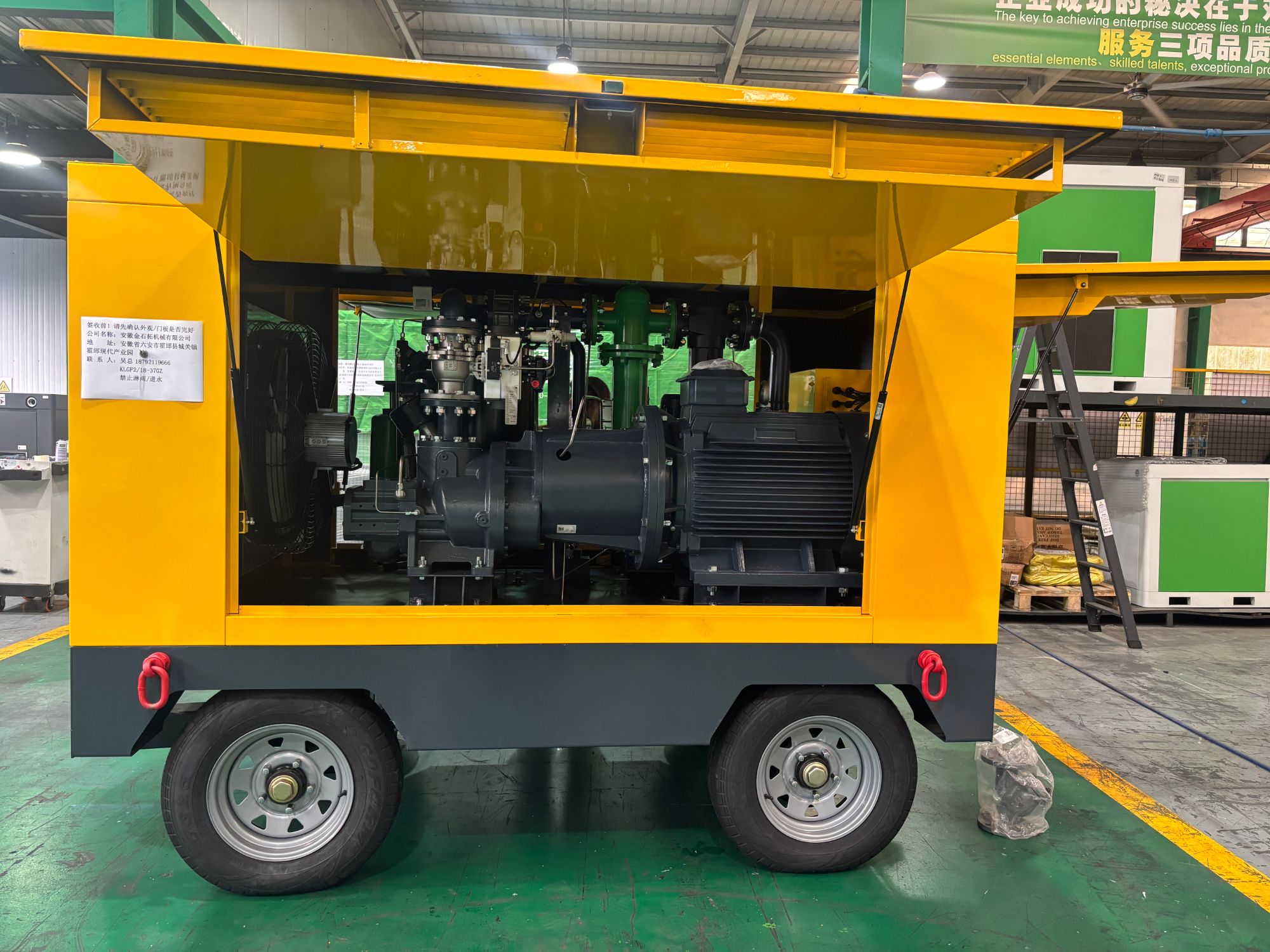
Underground mining and tunneling operations push compressors to the edge. Dust, moisture, fluctuating temperatures, and relentless demand separate machines that last from those that limp along. Rotary screw compressors generally handle these conditions with fewer breakdowns because their design has fewer moving parts in the compression chamber. The twin rotors don't touch each other or the housing, so wear is gradual and predictable. Reciprocating compressors, with their pistons, rings, and valves, create more friction points. In a gritty underground environment, those small parts can clog or fail faster, leading to more frequent maintenance shutdowns.
That said, reciprocating units can survive underground if the duty cycle is intermittent and the air demand is modest. They tolerate high-pressure spikes better than many rotary screws, which matters when running rock drills or other percussive tools. But for continuous ventilation, shotcrete spraying, or long-haul mucking operations, a rotary screw's ability to run 24/7 without overheating gives it a clear survival advantage. The oil-flooded screw design also seals in lubricant while cooling the air end, which helps keep internal temperatures stable even when ambient conditions swing from damp to dusty.
The real deciding factor often comes down to filtration and maintenance access. Underground crews rarely have time to rebuild a reciprocating compressor's valve plates or piston rings in a cramped drift. Rotary screw compressors can be serviced by replacing spin-on filters and checking oil levels without major teardown. If the unit is properly sized and fitted with heavy-duty intake filters to handle silica dust, a rotary screw will typically outlast a reciprocating machine in underground service. Choose the screw for survival; choose the reciprocating only for specialized, low-hour tasks where its pressure capability outweighs its fragility.
The Hidden Battle Against Heat and Humidity in the Compressor
Inside every compressor, a quiet war never stops. Heat builds up as air is squeezed into a smaller space, while humidity sneaks in with every intake cycle. Left unchecked, this combination degrades lubricants, corrodes internal surfaces, and forces the machine to work harder than it should. The result is not a sudden failure but a slow erosion of performance that most operators only notice when energy bills climb or output pressure starts to waver.
The real fight happens at the margins. Moisture that condenses after compression can mix with oil to form emulsions that lose their film strength, leaving metal parts exposed. Meanwhile, heat accelerates oxidation, turning once-clean oil into varnish that clogs narrow passages. Traditional drain valves and aftercoolers help, but they often react too slowly to changing ambient conditions. A compressor running through a humid summer night faces a very different enemy than one operating in a dry winter shop.
Winning this hidden battle means managing both variables as a single problem, not two separate ones. Air that is cooler but still wet will simply move the condensation downstream, while dry but hot air pushes thermal limits elsewhere in the system. Smart operators watch the dew point as closely as the discharge temperature, because the gap between them is where rust, sludge, and lost efficiency breed. In that narrow space, a few degrees or a few percentage points of relative humidity separate a compressor that lasts a decade from one that limps along after five years.
Why Clean Intake Air Is Harder to Get Than You Think
Most people picture an air filter as a simple screen that catches dust and bugs. But the moment intake air speeds up, even tiny particles turn into abrasive projectiles. In dry climates or near construction sites, the air carries silica and cement dust that chew through filter media faster than you'd expect. And once the filter loads up, the engine or compressor has to work harder just to pull in enough oxygen, which quietly steals power long before the "check filter" light ever comes on.
Humidity adds another wrinkle. Moist air makes paper elements swell and collapse, while oil-wetted foam filters can turn into a sticky mess that actually restricts flow. Cold starts are worse: condensation forms inside the intake tract, mixing with captured dust to form a paste that blocks airflow in spots you can't see without a borescope. That's why two identical machines in different regions can have wildly different filter life and performance, even with the same maintenance schedule.
Pressure Regulation: The Unsung Hero of Consistent Drill Power
Ask any seasoned driller what separates a clean bore from a wandering mess, and they'll rarely mention the obvious. They talk about feed rates, bit selection, or rock hardness. Yet behind every smooth, repeatable penetration lies a component that works in silence: pressure regulation. Without a stable air or hydraulic supply, the drill motor's torque curve becomes unpredictable. You feel it as that subtle hesitation mid-hole, the slight drop in RPM right when you need it most.
Most operators treat pressure as a set-and-forget setting. But dirt conditions shift constantly—clay pockets load the bit differently than fractured granite, and moisture can change everything. A well-tuned regulator responds to these changes before the operator notices. It flattens the spikes and fills the dips, keeping impact energy steady. That consistency is what lets a bit walk a straight line instead of skating off at the first hard seam.
The real payoff shows up on long runs. Drill components wear unevenly when pressure swings wildly, and that wear feeds back into erratic performance. A regulator that's slightly undersized or poorly maintained will cause more problems than it solves. On the other hand, a properly matched unit—one that accounts for line losses, altitude, and tool demand—turns a good drill into a predictable one. It's the difference between fighting the machine all day and letting it do the work.
Oil Flooded vs Oil Free: Matching Lubrication to the Mine's Reality
In underground mining, the choice between oil-flooded and oil-free rotary screw compressors often comes down to what actually happens at the face, not what looks better in a brochure. Oil-flooded machines tolerate dust, heat, and intermittent maintenance better; the oil seals clearances and carries away heat, which keeps them running when intake filters clog faster than planned. But that same oil becomes a contamination risk if a separator fails or condensate isn't managed, especially in narrow headings where air tools and refuge chambers can't tolerate any carryover.
Oil-free compressors remove that variable by design. They suit operations where compressed air contacts sensitive equipment, or where mine regulations make even trace oil unacceptable. The trade-off is a tighter tolerance for dirty intake air and higher bearing loads that demand more disciplined filter changes. In a wet, gritty development drift, an oil-free unit won't forgive neglect the way an oil-flooded screw often does.
The real decision usually comes down to the specific air users downstream. A longwall panel running roof supports and pneumatic controls may tolerate oil-flooded air with proper filtration, while a shaft-sinking crew running grout plants and instrumentation might not. Matching the compressor to the mine's reality means looking at where the air goes, how the maintenance team actually works, and whether the cost of downstream filtration outweighs the price premium of an oil-free package.
FAQ
On startup, the intake valve opens and the piston or rotary screw draws in ambient air through a heavy-duty filter. That air is then trapped in a shrinking chamber—whether between a piston and cylinder wall or between intermeshing rotors. As the chamber volume decreases, air molecules are forced closer together, raising pressure and temperature. The compressed air then moves into a storage receiver or directly into the mine's air distribution lines, where pressure switches and relief valves keep the output within the safe range needed for drills, loaders, and ventilation tools.
Underground mines can't rely on diesel or electric motors directly at every work face because exhaust fumes and electrical sparks pose explosion risks in confined spaces. Compressed air provides a clean, spark-free energy source that can be piped over long distances without the danger of combustion. It also powers ventilation boosters and emergency systems, meaning if the main power fails, a stored air reserve can keep essential tools and refuge chambers operating.
A single-stage compressor pulls air in and compresses it once before sending it out, which is efficient up to about 100 psi. For deeper mines that require higher pressures, a two-stage design compresses the air in the first cylinder, then routes it through a cooler and into a second, smaller cylinder for further compression. That staged approach reduces the heat load on each stage and cuts energy consumption compared to trying to reach the same high pressure in one jump.
Between compression stages, the intercooler lowers the air temperature before it enters the next stage. Hot air is less dense and harder to compress efficiently, so cooling it reduces the workload on the second stage and prevents lubricant breakdown or moisture buildup. In a mine, coolers often use water or ambient airflow—depending on the location—to bring the air temperature down close to the intake level.
Rotary screw compressors dominate many modern mining operations because they run continuously with fewer pulsations and handle variable demand well. Reciprocating piston units still appear in smaller or remote sites where high pressure and simple maintenance are priorities. Centrifugal compressors show up in large-scale surface plants that need very high flow rates. The choice usually comes down to air volume, pressure requirement, and how much space is available underground.
After compression, air passes through an aftercooler to condense water vapor, then into a moisture separator or dryer—often a desiccant or refrigerated unit. Filters remove oil carryover, rust particles, and fine dust that would otherwise jam rock drills or degrade hose linings. In mining, this cleanup stage is essential because the intake air near blasting or drilling areas can carry abrasive dust and high humidity.
Pressure relief valves open automatically if the discharge pressure exceeds a set limit, while high-temperature shutdown sensors cut the motor if oil or air temperatures climb too high. Automatic drain valves keep condensate from accumulating and causing corrosion or water hammer in the lines. Many units also have vibration monitors and emergency stop controls at both the compressor skid and the mine's main control room.
Conclusion
A mine air compressor doesn't simply squeeze air; it transforms atmospheric intake into a steady, high-pressure stream that drives drills, loaders, and bolters deep underground. Inside the compression cycle, air is drawn through an inlet, trapped in a shrinking chamber, and discharged at higher energy. The choice between rotary screw and reciprocating designs often comes down to operating conditions. Rotary screw units, with their continuous rotary motion, tolerate dust and vibration better in day-to-day underground use, while reciprocating machines, though efficient at high pressures, demand more maintenance when grit works into valves and rings. Underground, heat and humidity add another layer of strain: as air is compressed, its temperature rises sharply, and moisture condenses inside lines, threatening corrosion and tool wear unless aftercoolers and drains manage the load.
Clean intake air is harder to secure than surface operators assume. Mine air carries coal dust, silica, diesel soot, and blasting residue; without multi-stage filtration, these particles score rotors, clog valves, and shorten compressor life. Pressure regulation remains the quiet workhorse of consistent tool performance. A well-tuned regulator holds pressure within a narrow band despite fluctuating demand from multiple drills starting and stopping, preventing both starved tools and wasteful over-pressurization. The oil-flooded versus oil-free decision hinges on the mine's reality: oil-flooded screw compressors offer cooler running and longer rotor life but risk oil carryover into air lines, while oil-free machines eliminate that contamination at the cost of higher discharge temperatures and tighter tolerances. Matching these choices to dust levels, humidity, and maintenance access determines whether the compressor stays reliable or becomes another underground breakdown.
Contact Us
Contact Person: Mia
Email: [email protected]
Tel/WhatsApp: +86 19821985894
Website: https://www.seize-air.com